Dear reader,
Let me tell you a story that might sound familiar.
A few months ago, a friend called me. It was a Thursday, almost 10 PM. She was crying.
We talked for an hour. And as she spoke, I realized something: she wasn't just describing her life. She was describing the life of almost everyone I know.
Including mine, until recently.
The Pattern No One Chose
Think about your day yesterday.
How many notifications did you receive? How many decisions did you have to make? How many times did you feel like you were juggling plates, trying not to let any drop?
Now think about your home. Your closets. Your desk. Your phone.
How many things there do you actually use? How many just... exist?
I'm not judging. I'm recognizing a pattern I see everywhere:
- We accumulate without noticing.
- We overcommit ourselves.
- We live at 2x speed without questioning why.
And the result? That constant feeling of always running but never arriving. Of having much, but feeling little. Of being connected to everything, except what matters.
The Accidental Discovery
My journey with minimalism began in a very unphilosophical way: I had to move to a smaller apartment.
Suddenly, I faced years of accumulation. Boxes I hadn't opened in 5 years. Clothes with tags still on. Books I swore I'd read "someday." Gadgets that promised to revolutionize my life (and were sitting in a drawer).
Forced by circumstance, I started to question: Why do I have this? Do I really need it? When was the last time I used it?
And then something unexpected happened.
As I let go of the excess, I felt something beyond physical space opening up. It was as if every unnecessary object that left took with it a mental weight I didn't even know I was carrying.
The move, which was supposed to be stressful, became... liberating.
What I Discovered in the Process
Curious about this feeling, I started researching. I read about minimalism, voluntary simplicity, essentialism. I talked to people who lived with less. I studied different approaches and philosophies.
And I discovered something important:
It's not about living with 33 items of clothing or sleeping on the floor. It's not about judging who has more or competing for who has less.
It is something simpler and deeper: it is questioning the automatic.
Why do we buy what we buy?
Why do we keep what we keep?
Why do we say yes when we want to say no?
Why do we fill every minute of the day?
They are simple questions. But the answers can change everything.
The Guide Born from Practice
For months, I documented my journey. The mistakes (many), the successes (some), the discoveries (revealing).
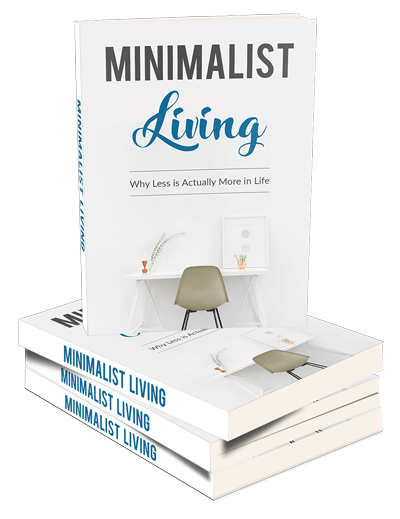
I organized everything into a practical guide: Minimalist Living: Why Less Is Actually More.
I'm going to be completely transparent about what you will learn and apply:
Inside the Guide You Will Discover:
- ✓ Why you accumulate without noticing — and how this automatic pattern is sabotaging your peace of mind without you knowing
- ✓ The difference between real minimalism and Instagram trends — debunking myths that stop ordinary people from simplifying their lives
- ✓ The "3 invisible costs" method — how to identify where excess is draining your energy, time, and money
- ✓ The "clutter map" exercise — a visual tool to see where chaos hides in your life (not just in closets)
- ✓ The "single decision" technique — how to eliminate hundreds of daily micro-decisions and free up mental energy
- ✓ The "one in, two out" system — the simplest way to prevent excess from accumulating again
- ✓ How to transform your environment into an ally — creating spaces that naturally promote calm and focus
- ✓ The "non-negotiable" principle — how to say no without guilt and protect your real priorities
- ✓ The "void blocks" strategy — why empty spaces in your schedule are productive and how to create them
- ✓ How to simplify your finances in 3 steps — reducing automatic expenses you don't even remember you have
- ✓ The "digital sunset" method — reclaiming 2 hours of your day without giving up necessary technology
- ✓ The 90/90 rule for clothes and objects — when to keep, when to donate, when to discard (without regret)
- ✓ The concept of "flexible minimalism" — adapting principles to YOUR life, without extremism
- ✓ The "emotional inventory" technique — identifying what you keep out of fear, guilt, or "what if..."
All this in 72 direct pages, no filler, no unnecessary theory.
What This Guide Does NOT Promise
I need to be clear:
- ❌ It is NOT a revolutionary method — these are known concepts, organized practically
- ❌ It will NOT change your life in 21 days — real changes take time
- ❌ There are NO magic formulas — it offers reflections and tools, you do the work
- ❌ It is NOT for everyone — if you are happy with your current life, you don't need this
- ❌ It DOES NOT replace professional help — if you are in mental distress, seek specialized support
Who This Guide Might Be Useful For
I wrote it thinking of people who:
- Feel that life is too complex
- Spend energy on things that don't matter
- Want more clarity and less noise
- Seek practical ways to simplify
- Are open to questioning the automatic
- Prefer gradual changes
If you identify with this, you might find value here.
The Investment and Real Return
It's not much. But it might be enough to start significant changes.
Access Minimalist LivingSimple and Honest 30-Day Guarantee
If you don't find at least ONE useful idea that you can apply, ask for a refund.
No forms. No questions. Just an email.
A Real Story of Application
Remember my friend from the beginning of the letter?
I shared an early version of this guide with her. She didn't become a radical minimalist. She didn't drop everything to live in a cabin.
But she made small changes:
- Cancelled 3 subscriptions she didn't use
- Created a work "uniform" (fewer morning decisions)
- Set a time to turn off her phone
- Donated half the wardrobe she didn't use
- Said "no" to commitments that didn't align with her priorities
Three months later, she called me again. This time, she wasn't crying.
"It didn't change everything," she said. "But it changed enough. I can breathe now."
That's what it's about. Not perfection. Breathing.
My Sincere Invitation
If you've reached this point, you've already invested considerable time reading this letter. That tells me two things:
- The theme resonates with you in some way
- You are genuinely seeking change
The complete guide is one click away. For less than a special coffee, you'll have access to months of research and practice organized clearly and applicably.
But I want to be honest: the guide is just a tool. The real work — of questioning, choosing, changing — is yours. If you are ready for that work, the guide can help.
A Final Reflection
We live in a unique time in human history. We have access to more information, products, and opportunities than any previous generation.
And yet (or perhaps because of it), so many of us feel that something is missing.
Maybe what's missing isn't more of something. Maybe it's less.
Less noise to hear what matters.
Less haste to be present.
Less excess to find the essential.
If this reflection makes sense to you, consider the guide as a companion on that journey.
Not as a guru. Not as a formula. Just as a friend who walked the path before and left some signs along the way.
With simplicity and sincerity,
Author of Minimalist Living
P.S. If you decide not to acquire the guide, here is a free tip worth more than $7: choose ONE area of your life this week — a drawer, email, appointments — and simplify just that. See how you feel. If you like the feeling, continue. If not, at least you tried. Change always begins with a first step, not a guide.
P.P.S. For full transparency: this is a digital product, PDF format, with 72 pages. You will receive immediate access after purchase. There are no upsells, no recurring charges, no tricks. Just the guide, for $7, with a 30-day guarantee. Simple as that. As it should be.